Roth vs Whole Life: Start Before RMD Age
Feb 19, 2026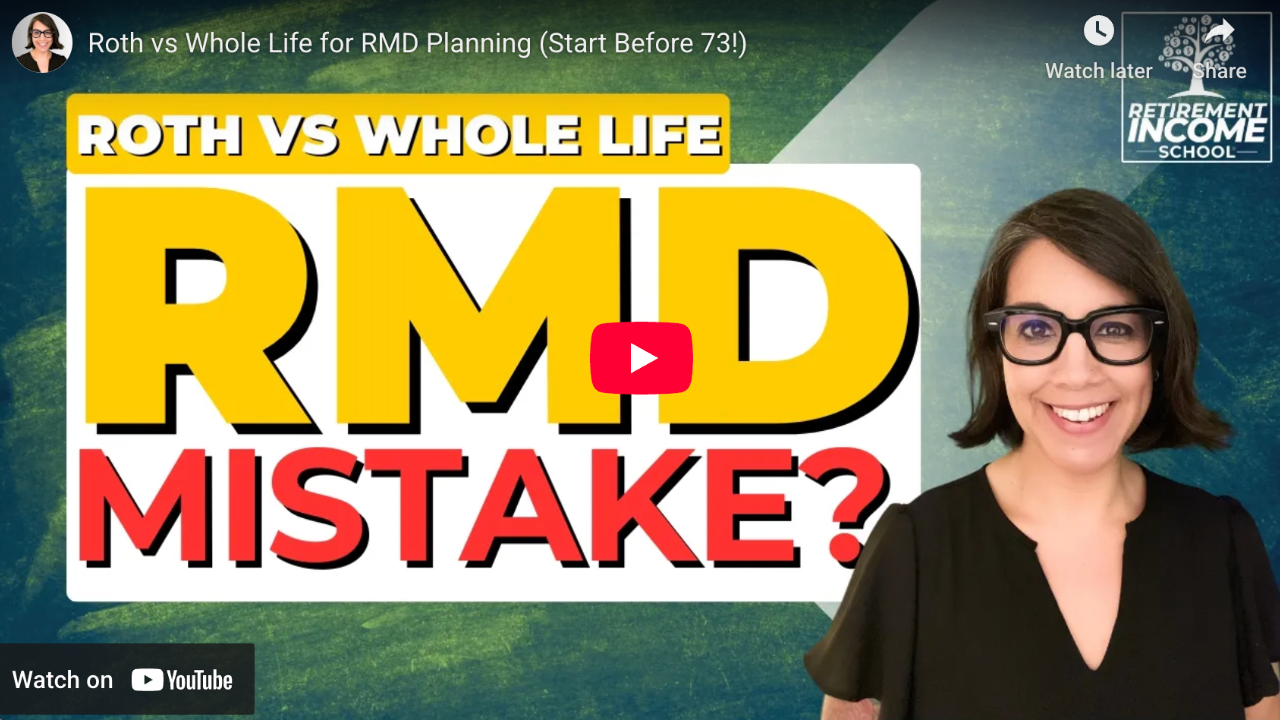
Required Minimum Distribution planning is not a 73-year-old problem.
It’s a 55-year-old opportunity.
If you’re asking at age 73 whether whole life can eliminate your RMDs, you may already be in reactive mode. And I don’t say that to scare you. I say it because eliminating RMDs is not the same thing as positioning early so RMDs never become overwhelming.
One of the biggest problems with RMDs is that they grow over time. As your IRA compounds, your required distributions get larger — and that can trigger a chain reaction:
-
Higher tax brackets
-
Increased Medicare premiums
-
Greater taxation of Social Security
-
The widow’s penalty
-
Long-term tax pressure on your retirement income
The key isn’t just eliminating RMDs.
The key is controlling them early.
Whole Life Does NOT Eliminate RMDs
Let’s be clear.
Whole life does not eliminate RMDs.
Roth conversions do eliminate future RMDs — on the amount converted.
These are different tools with different outcomes.
If you’re thinking about whole life at age 73 as a way to “fix” RMDs, you’re likely responding to IRS rules instead of designing your future.
Whole life is not an RMD escape hatch.
It’s a pre-RMD reallocation strategy.
Why Waiting Until 73 Is Reactive Planning
If you wait until RMD age to think about whole life, here’s what happens:
-
Premiums are higher
-
The compounding window is shorter
-
Cash value has less time to grow
-
Underwriting risk increases
-
RMDs may already be turned on
That’s reactive planning.
You’re managing the damage instead of shaping the outcome.
Why 55–65 Is the Strategic Window
When you start planning earlier, everything changes.
If you begin repositioning in your mid-50s to mid-60s:
-
Cost per dollar of coverage is lower
-
You gain more years of compounding
-
Policy efficiency improves
-
You create a non-market “safe money” bucket
-
You can gradually shrink your IRA before RMD age
This is the difference between reacting at 73… and planning at 55.
Elimination vs. Repositioning: Two Very Different Strategies
Understanding the difference between Roth and whole life is critical.
Roth Conversions: An Elimination Strategy
-
Pay taxes now
-
Converted dollars permanently leave the RMD system
-
No lifetime RMDs on Roth IRAs
-
Future growth is tax-free
Roth is a tax strategy. It directly shrinks your IRA.
Whole Life: A Repositioning Strategy
-
Withdraw IRA funds gradually
-
Pay taxes intentionally
-
Fund premiums with net proceeds
-
Reduce IRA balance over time
-
Build a protected, tax-advantaged asset
Whole life shrinks the IRA gradually while building a new asset class.
You’re not just moving money from IRA to Roth (same asset class).
You’re repositioning into a safe-money vehicle with guarantees and leverage.
Why Repositioning Early Matters
If your IRA is compounding faster than your tax strategy, you don’t have a growth problem.
You have a future control problem.
The longer you wait, the larger the tax time bomb can become.
Repositioning earlier gives you more options, more flexibility, and more control.
What Whole Life Can Offer (When Started Early)
When properly structured and funded before RMD age, whole life can provide:
-
Contractual guarantees
-
Reduced market exposure
-
Estate leverage through a tax-free death benefit
-
Tax-advantaged access to cash value
-
Greater control over long-term income planning
It’s not about avoiding taxes.
It’s about adding stability and leverage to your retirement strategy.
What Whole Life Does NOT Do
Whole life does not:
-
Eliminate RMDs automatically
-
Avoid taxation on qualified withdrawals
-
Replace Roth conversions entirely
Qualified dollars must still be withdrawn and taxed before funding a policy.
And whole life requires underwriting. It must be structured properly. It builds over time.
That’s why timing matters.
When Roth Conversions Make More Sense
Roth may be the better strategy if:
-
You’re in a lower tax bracket today
-
You have a long time horizon
-
Your primary goal is eliminating RMDs
-
You’re comfortable with market exposure
Roth is ideal when the mission is pure tax elimination.
When Whole Life May Make More Sense
Whole life may fit better if:
-
You prefer conservative, guaranteed growth
-
Estate planning is a priority
-
You want reduced market volatility
-
You value leverage for your heirs
-
You want more control over retirement income structure
Whole life shines when the mission is long-term control and leverage.
The Most Advanced Strategy Isn’t Either/Or
For many retirees, the most sophisticated approach is layered:
-
Strategic Roth conversions
-
Early whole life repositioning
-
Guaranteed income planning
This creates:
-
Tax diversification
-
Risk diversification
-
Income diversification
-
Legacy leverage
That’s holistic retirement planning.
The Real Question
The real question isn’t:
“Can whole life eliminate RMDs?”
The real question is:
Are you starting early enough to prevent RMDs from becoming a problem?
RMD planning begins long before age 73.
It begins when you decide to take control.
Ready to Retire Financially Relaxed?
My goal is to help you eliminate the fear of running out of money, avoid costly mistakes, and retire with confidence and security. When you have safe, predictable income in place, you’re free to actually enjoy retirement — not just worry your way through it.
👉 Learn more at the Retirement Income School™.
📞 Want to talk? Schedule a Retirement Income Q&A Call — let's get a plan in place for you!
DISCLAIMER:
The information in this lesson is provided for general educational purposes only and does not constitute financial, legal, or tax advice. Retirement Income School™ and Dr. Amanda Barrientez do not provide individual investment recommendations. Always consult with a licensed advisor or tax professional before implementing any strategy discussed.